
Three Misconceptions On Modern Banking and Money
UC Berkeley has top-five economics and business schools. Yet, after taking classes in both, I’ve had to unlearn everything I was taught about how the financial machine works. What we read in school is mostly wrong and not reflective of modernity.
I want to summarize three critical points in understanding the monetary stack.
Banking Triumvirate
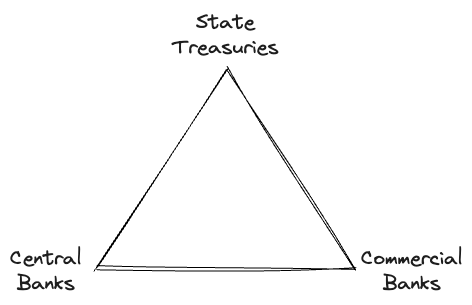
Credit to Luca Prosperi for this illustration.
Banks are part of a state apparatus consisting of state treasuries, central banks, and commercial banks. They are not private companies as one typically thinks of them.
Let’s focus specifically on the relationship between central banks and commercial banks. Central banks have a mandate dictated by the federal government that controls their operation. In the US, this is the dual mandate of low inflation and full employment.
Central banks leverage commercial banks to carry out that mandate. They give commercial banks the exclusive right to create and destroy money out of thin air in return for the hard work of creating and maintaining the financial plumbing that individuals and businesses use on a daily basis.
Part of this financial plumbing is also making sure the newly minted dollars are going to the right individuals and businesses. Because the government is incapable of this level of work, it leverages the competitive incentives of private markets.
Such an exclusive right to create money is incredibly valuable, which is why commercial banks are $100B+ businesses. This relationship between commercial banks and central banks is also why commercial banks are considered “systemic” because they are very much part of the core federal operation of maintaining a money supply.
As commercial banks occupy a “Schrodinger’s cat” situation between a public and a private entity, sometimes their private interests in maximizing shareholder value win out, and they end up taking obscene risks with their balance sheets, leading to catastrophe.
In response, regulators impose more regulation, which makes banks less fit to carry out their original purpose, leading to instability in the system. We covered this in an older blog post here.
Such a tight relationship is also why, until crypto, innovating in financial market structures was impossible. I studied capital markets companies founded over the past 30 years and found that they either were started by a coalition of banks, like Visa or had to sell out a major equity stake to a coalition of banks, like the Intercontinental Exchange.
Banks Do Not Lend Savings
This is such a counterintuitive point to what we are taught in school that, in 2014, the Bank of England put out a blog post specifically to explain how money was created.
Here is an excerpt:
In the modern economy, most money takes the form of bank deposits. But how those bank deposits are created is often misunderstood: the principal way is through commercial banks making loans. Whenever a bank makes a loan, it simultaneously creates a matching deposit in the borrower’s bank account, thereby creating new money.
Most deposits in the banking system are simply loans created by banks! In a totally digital age, the notion of lending out savings is unnecessary. That was an extra step when money was an actual physical thing that you needed to pay for goods and services.
Rather than receiving deposits when households save and then lending them out, bank lending creates deposits. Another way to think of this is that when a bank lends out money, it is not transferring some small amount collectively out of everyone’s account into the borrower’s account; it is simply incrementing the borrower’s deposit balance in their account and creating new money in the process.
Though, of course, as we discussed in the previous section, this is done in partnership with the central bank. The central bank controls commercial bank money creation by having reserve requirements based on the types of loans the bank has on its balance sheet. Reserves are the amount of “base currency” or equivalents, like treasuries, that a bank must hold in its account with the central bank. This is money that only the central bank can issue.
Such reserve requirements are codified in the Basel III accords and essentially mean that the more risky loans the bank makes, the more it must have in reserves. This is to control the amount of money creation a bank can do and force it to be in line with the central government’s goals for the economy. So, a bank cannot mint money for whatever it wants.
Shadow Banking is Now Banking
As banks failed, especially following the Great Financial Crises, regulators imposed stricter reserve requirements, monitoring standards, and the scope of a bank's product offerings. Because of these strict requirements, the scope of profitable lending opportunities that banks can engage in narrowed considerably.
Businesses and individuals still need these loans. As such, banking has now moved to an unregulated sector of the economy, where financial intermediaries provide banking-like services but are not banks.
Consider this recent news story describing the relationship between Barclays and Blackstone:
For years, Barclays Plc struggled with what to do about its US credit-card business. It was a cash generator, cranking out a steady stream of revenue, and yet it was costly to run because of the way regulators force banks to set aside capital as a buffer against losses.
The British lender came up with a solution in February by selling $1.1 billion of card assets to private equity firm Blackstone Inc. The transaction, part of an ongoing financing arrangement, allows Barclays to collect fees for servicing the loans but not have to hold them on its books. In return, Blackstone gets to generate high yields for insurance clients.
In essence, Barclays is renting Blackstone’s balance sheet. …
The Barclays-Blackstone deal received little attention at the time but may have marked a new chapter in the lending industry's evolution since the global financial crisis. As capital rules have gotten tougher, banks have had to exit certain businesses or cede market share to non-bank rivals. Now, they are partnering with those rivals in ways that benefit both parties—even if it is unclear how regulators might react.
Soon after Barclays and Blackstone announced their tie-up, KeyCorp and Blackstone unveiled a similar partnership. In interviews, executives at several private credit providers said they are holding conversations about more deals, including with some of the largest US banks.
This is a recent and phenomenal encapsulation illustrating the point.
Banking has moved away from the model of “originate to lend” to “originate to distribute.” Originate to lend is where banks originate loans and keep them on their balance sheet until maturity. A model we are most familiar with. Originate to distribute is a new model where banks use their existing customer relationships and product lines to originate loans, but instead of holding the loans on their balance sheet, they sell these loans to insurance funds, pension funds, asset managers, etc. In return, they keep an origination fee and often have ongoing revenues from managing the debt position.
However, this is simply regulatory arbitrage. Fundamentally, money creation has to happen for the Fed to keep its mandate, be it through banking or the shadow banking sector. The shadow banking sector creates credit without the protection of programs like the FDIC and thus has to come up with new financial innovations for managing liquidity. A lot of the designs for my protocol come from what the shadow banking sector created.
Additionally, shadow banks don’t have an account with the FDIC, so they can’t engage in the same money creation process that commercial banks can, making the substitution imperfect.
Conclusion
Banking is a core societal institution that works in synchrony with public institutions to maintain a money supply and a strong economy. Banks have a privileged position in creating money to meet the needs of the economy, but this relationship is breaking down. The emerging shadow banking sector, which is wholly unregulated, is taking on more core banking services.
However, the shadow banking sector cannot create money like the banking sector, and thus, we find ourselves in an unstable equilibrium as the nature of banking is changing once more. Where this ends up going and how technologies like blockchains and Central Bank Digital Currencies fit in is the trillion-dollar question.
Further Reading
If this is interesting to you, please reach out! We're happy to share more of the research we’re doing at Bestia.